5月6日,宝马集团发布2026年第一季度财报。一份"利润率守住、销量承压"的成绩单,再一次把中国市场的角色推到台面上——它究竟是宝马整体业务的支撑者,还是包袱?
这个问题的答案,将直接决定宝马即将上市的新世代iX3长轴距版——以及晚一年才会国产的新世代i3长轴距版——是会成为反攻号角,还是仅仅是一次"豪华品牌走入中国市场红海"的悲情注脚。
一、Q1财报: 守住了利润率,但销量与收入双降
先看几个核心数字。
2026年Q1,宝马集团营收310.1亿欧元,同比下滑8.1%;税前利润23.48亿欧元,同比下滑24.6%;归属净利润16.72亿欧元,同比下滑23.1%。汽车业务的息税前利润(EBIT)13.45亿欧元,同比下滑33.5%;EBIT利润率5.0%,落在4-6%全年指引区间的中段。
数字本身不算亮眼,但财报中真正值得关注的是利润率。集团7.6%的税前利润率,几乎与去年全年7.7%持平;汽车业务自由现金流7.77亿欧元,同比+88.1%——这意味着宝马的现金流质量并未因销量下滑而走样。
一个被市场忽略的指标:金融服务渗透率。Q1宝马金融服务渗透率达到51.6%,同比上升8.6个百分点——这是该指标历史上首次过半。换言之,每卖出一台宝马,就有超过一台是通过宝马金融租赁或贷款完成的。即便整车销售承压,宝马也能通过金融业务获得稳定收入与客户粘性。
▍宝马2026 Q1财报核心数据
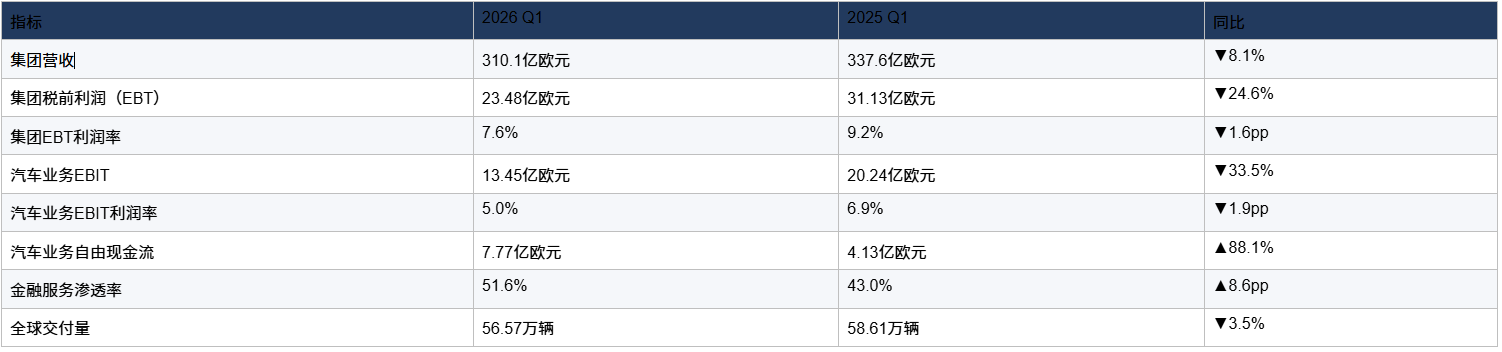
*数据来源:宝马集团2026年Q1官方财报。关税单项拉低汽车业务EBIT利润率1.25个百分点。
换句话说,如果剔除关税的影响,宝马汽车业务的Q1 EBIT利润率应在6.25%左右,仍处于全年指引的上沿。宝马集团首席财务官沃尔特·梅尔特表示,一季度的盈利再次表明宝马"战略连贯性、运营韧性以及高度灵活性"的价值所在——这句话的真正含义是:在销量与利润之间,宝马依然选择守住后者。
二、中国市场: 是支持还是拖累?
要回答这个问题,需要把镜头先拉回到2025年10月7日。
那一天,宝马集团董事会下调了2025年全年指引。在官方公告中,董事会列出了几个原因,其中一条特别值得玩味——
"中国本地银行的金融与保险产品销售佣金大幅下降,需要公司提供财务支持,以维护经销商的盈利能力。"
这是一句被国内媒体大多忽略的关键表述。它的真实含义是:在中国市场销量持续承压、价格战难以转嫁、本地金融机构给经销商的金融服务佣金被压缩的背景下,宝马集团需要拿自己的钱,去补贴中国经销商的盈利缺口——为了保住他们不退网,为了等到新世代车型上市时还有完整的渠道。
代价有多大?看一组对比即知。10月这次指引下调中,宝马汽车业务全年自由现金流从"高于50亿欧元",被砍至"高于25亿欧元"——足足腰斩。汽车业务EBIT利润率指引也从5-7%下调至5-6%。这些下调中,部分来自关税延迟退还,但很大一部分,正是用于给中国经销商网络"输血"。
▍2025年宝马为中国市场所做的"非常规支出"

*数据来源:宝马集团2025年10月7日官方公告、2025年全年财报。
▍来自CFO的官方解释
在10月7日宝马集团IR电话会议上,CFO沃尔特·默特尔(Walter Mertl)对Q4具体动作作了进一步说明,原话如下——
"我们引入了经销商补偿支付,从季度调整为月度,持续到年底。"("We introduced dealer compensation payments through the end of the year with monthly rather than quarterly payments.")
"这些影响加上前面提到的中国市场情况,使我们预期汽车业务自由现金流将高于25亿欧元(此前为高于50亿欧元)。"("These effects together with the China market situation outlined earlier mean we expect Segment Automotive free cashflow to be above €2.5bn (previously: above €5bn).")
两句话之间,CFO清清楚楚把"经销商补偿支付的月付化"和"汽车业务自由现金流指引腰斩"放在了一段叙述里——前者是动作,后者是后果。这种月付化的安排意味着:宝马把对经销商的补贴节奏从"季度结算"改为"月度立结",目的是让经销商现金流更稳,避免他们在Q4因周转压力被迫退网。
▍这笔钱大概有多大?
需要先说明一句:宝马没有在任何公开财报中单独披露"中国经销商支持"的具体金额。但从指引调整的差额,可以做一个相对粗略的反推。
2025年10月7日,汽车业务全年自由现金流指引被一次性砍掉25亿欧元(从>50亿欧元降至>25亿欧元)。CFO默特尔同时说明,其中关税退还时间错位带来的影响是"high three-digit million"(约7-9亿欧元区间)——这部分严格意义上不是损失,而是退还时点延迟到2026年。
剔除关税时间差,剩余的下调幅度在15-17亿欧元之间。这部分主要由两块构成:(1)Q4中国销量目标的下调;(2)对经销商的财务支持。其中"经销商月度补偿支付"是公开提及的具体支出动作。
一个相对保守的推算:如果"销量调整"与"经销商支持"大致各占一半,则2025年宝马为支持中国经销商所付出的财务代价大约在8-10亿欧元——按当前汇率折算,约合人民币64-80亿元。
需要强调的是,这只是基于公开指引差额的反推,并非宝马官方披露的数字。实际金额可能因为分摊口径不同(计入营收减项、还是Q4单独的补贴支出)而有出入。但即便取保守值,"约合64-80亿人民币"这个量级,已经足以说明宝马在2025年为维护中国渠道所做的财务让渡,是一个真实存在、并且不小的数字。
到2026年3月发布的2025全年财报中,宝马进一步明确:全年营收下降6.3%(至1334.53亿欧元),主要原因之一就是"对中国经销商网络的支持"(support for the dealer network in China)。换句话说,这笔钱没有进财报的"利润"项,而是直接抵消了集团的营收。
为了对冲这笔支出,宝马在2025年同步推进了三件事:研发支出、资本支出、销售管理费用同时压缩,全年累计降本25亿欧元;同时通过股票回购维护股东信心;并在新世代车型量产前不动声色地完成大中华区高层换帅(柯睿辰自2026年4月1日接任)。
但即便如此,渠道收缩仍在加速。
▍宝马在华4S网点变化:一年净减84家

*数据来源:宝马在华经销商网点统计。
这组数据,是对"宝马为何要给经销商砸真金白银"最有力的注脚——一年时间里,宝马在华4S店净减84家(从655家降至571家),单季度4S店关店数量从2025 Q1的9家飙升至2026 Q1的26家,新建几乎停滞(仅6家)。与此同时,"其他网点"(2S店/服务点)逆势增加4家,这是渠道降级的典型信号:经销商把成本更高的4S店改为成本更低的2S/服务点,以求活下去。
换一个角度看:如果宝马2025年没有提供这笔财务支持,关店数字大概率不止26家。所谓的"输血",其实是在阻止一场更大规模的退网潮。
回到Q1财报。2026年Q1,中国乘用车上险量同比下滑17.3%;其中,德系品牌整体同比下滑14.8%。豪华车市场的折扣率长期居于20%以上的高位,宝马的成交均价较五年前已下滑18%至约33万元人民币。在这样的市场环境中,宝马公布的Q1全球财报口径(发往经销商的交付量)在华为14.4万辆,同比下降10%——下滑幅度小于德系平均水平,更小于市场总盘的下滑速度。
但如果把镜头切换到终端真实的"上险数据",画面就会立刻不一样。
▍财报口径 vs 上险口径:被忽略的1.87万辆差距
两个口径反映的是两个不同环节——
财报"交付量"(deliveries):工厂发往经销商仓库的批发数;
上险数据(registrations):消费者实际办理上牌的零售数。
Q1宝马在华的两个口径对比如下:

*数据来源:宝马集团2026年Q1财报;桑之未上险数据。
这组对比信息量极大——
第一,终端真实下滑8.5%(上险口径),与财报呈现的10%(交付口径)基本一致,宝马在Q1做了相对克制的批发安排。但消费者真正"上牌买走"的车,比财报数字仍少了1.87万辆。这1.87万辆的差额,部分体现为经销商在Q1期末仍在仓库里的库存。
第二,纯电动同比▼65%,是宝马在华最大单项跌幅。这与第三章我们将看到的"现款iX3断崖、i3独自支撑"曲线完全吻合——5,218辆纯电中绝大部分是i3在贡献。
第三,1.87万辆库存差,正是"经销商压力"的第三重佐证。财务支持的钱已经砸下去了、4S店净减84家已经发生了,但终端的真实需求疲弱仍在让经销商手中积压库存——这意味着,2026年Q2-Q3,宝马在华的"为经销商输血"模式可能仍需延续,直到Q4新世代iX3上市才有望真正改变这一局面。
▍中国市场Q1关键数据 vs 宝马在华表现
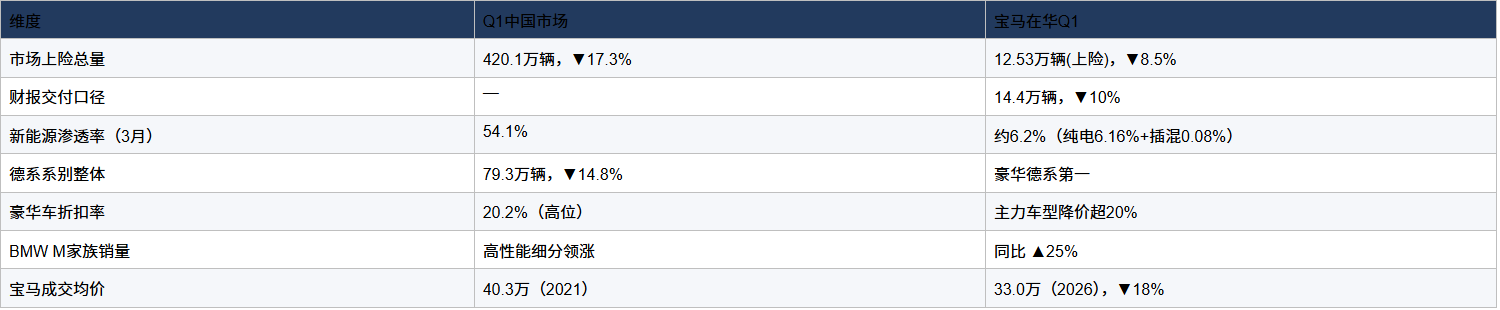
*数据来源:桑之未上险数据;宝马集团公告。
从总量结构看,中国对宝马依然至关重要:2025全年宝马在华交付62.55万辆,占集团全球总销量25.4%,依然是宝马的最大单一市场。但需要直面的是:中国市场对宝马整体利润的"杠杆效应"远大于其25%的销量占比。回看2024财年,宝马集团44亿欧元利润降幅中,超过一半来自中国市场的销量下滑与价格压力(折合人民币约170亿元)。2025年虽未给出同样具体的拆解,但全年中国销量▼12.5%、关税与本地价格竞争双重压力,迫使宝马通过25亿欧元的成本节降才将集团利润率维持在7.7%——这本身就说明,中国市场的承压依然是宝马整体业绩的最大变量。
综合判断:中国市场对宝马Q1业绩,是短期拖累,但长期支持。短期看,销量与价格双降直接侵蚀集团利润,2025年的"为渠道输血"更是直接吞噬了集团一半的自由现金流;长期看,中国是宝马新世代技术兑现的主战场——新世代电驱、本土AI生态、Momenta辅助驾驶——全部在中国完成研发与量产化。离开中国,宝马的电动化叙事就失去验证基地。
真正的问题不是"中国是不是包袱",而是:宝马即将投放的新世代产品,能否把中国市场从"拖累位"重新拉回"支持位"?
三、定价之困: 新世代iX3、i3将面对怎样的市场?
要评估宝马新世代iX3长轴距版(2026年Q4上市)与新世代i3长轴距版(2027年国产)的竞争力,必须先理解一个事实:它们将进入的,是中国新能源市场最卷、最不留情面的两个细分赛道。
先看iX3的"价格底牌"。现款iX3官方指导价39.99-43.99万元,但终端的真实成交价格,已经远远低于这个数字。综合多渠道数据:2024款iX3终端裸车价已下探至23-29万元区间,部分版本的优惠幅度高达17.3万元,实际成交价"进入20万元区间"——这意味着,宝马在中国的渠道里,iX3的指导价与终端价之间已经形成接近15万元的价差。这是宝马渠道在过去两年价格战中的真实承压。代价是,2025年iX3的单月销量一度跌至两位数,几乎退出了主流竞争。
这个"已经在20万元区间售出"的现实,正在直接锚定市场对新世代iX3的价格预期。
▍新世代iX3国产版:30万元成为关键门槛
多家汽车媒体在2025年9月新世代iX3慕尼黑全球首发后即援引内部消息,明确提到:国产版新世代BMW iX3长轴距版的预期起售价"约在30万元区间",初期将以两驱版本为主。
而在2025年12月一篇广为流传的西班牙海外试驾报道中,汽车额媒体人给出了更直接的判断:"如果这辆车起售价能低于30万,那小米YU7等车型都有点危险了。"
这一句话,把新世代iX3的定价之困摆得一清二楚——产品力被认可("我们记忆中的宝马回来了"),但要真正具备杀伤力,必须把指导价压到30万元以下。问题在于:以宝马的成本结构、品牌定位、以及全新平台的研发摊销压力,30万元以内的指导价几乎是个"自伤式"的选项;而如果定在35-40万元,又面临国产竞品已经形成的稳定市场预期。
新世代iX3的技术配置——CLTC续航900公里、800V架构、108度大圆柱电池、与Momenta合作的辅助驾驶——已经对齐第一梯队,但价格上面临的,是已经形成稳定市场预期的对手矩阵。
▍中型纯电SUV市场:iX3的主战场

*数据来源:各品牌官方信息整理。新世代iX3长轴距版预计2026年Q4上市。
从表格不难看出:新世代iX3的续航、三电、智能化已无明显短板,但其品牌溢价空间正在被严重压缩。如果传闻的"30万元起"成真,新世代iX3将与小米YU7、智界R7、极氪7X直接贴身肉搏;如果指导价定在35-45万元区间,那么参考现款iX3的"指导价÷终端价≈1.74"经验值,终端实际成交价大概率仍会回到20-25万元区间——本质上仍然是与国产新势力在20-30万元价格带的正面对垒。
换言之,无论指导价如何制定,新世代iX3最终都会被中国市场重新"锚定"到20-25万元的真实成交区间。这就是宝马在中国的定价之困——不是"想定多少就能定多少",而是"市场已经在用现款车的终端价,给新车上预设了天花板"。
▍现款iX3的"销量崩塌"与"产能让位"
上述判断不是凭空而来。一组现款iX3的真实销量轨迹,揭示出宝马在2025年悄悄完成的产能切换。
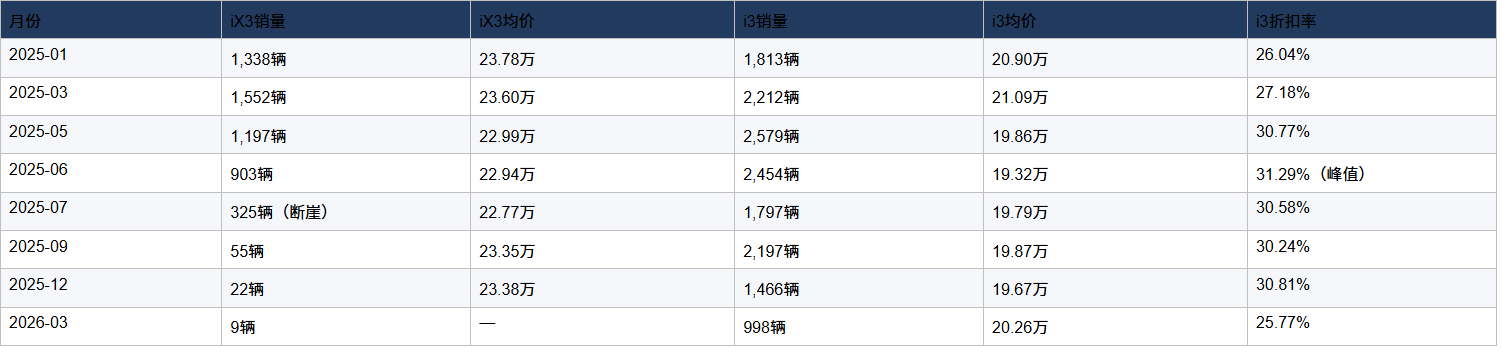
*数据来源:宝马iX3和i3月度上险及成交价数据。折扣率为宝马品牌折扣中位数。
数字本身已经把故事讲得很清楚:
第一,iX3的销量在2025年7月出现断崖式下滑——从6月的903辆直接跌到7月的325辆(-64%),8月跌至103辆,9月55辆,之后稳定在两位数。这不是终端需求自然萎缩,而是主动停产、为新世代iX3让产能的典型曲线。从2025年Q1到2026年Q1,iX3销量从3,931辆跌至32辆,同比▼99.19%。
第二,iX3的成交价相对稳定在23万元区间——这意味着即便终端折扣猛烈(指导价÷成交价≈1.74),宝马依然没有在最后阶段盲目"跳水",而是有节奏地清库存,把产能切换到新车。
第三,i3独自支撑了宝马在华纯电基本盘。2025年Q1 i3销量5,413辆,2026年Q1降至2,338辆(▼56.8%),但仍是宝马在售纯电中的绝对主力。i3的折扣率从2025年6月的峰值31.29%,到2026年Q1回落至25-30%——这正是1月宝马"全系官降+经销商让利收窄"组合拳的效果。
▍新世代i3不再是2026年Q4的故事
一个值得重新校准的产品节点:业内最新信息显示,新世代BMW i3长轴距版的国产时间已推迟至2027年——这与早前预期的"2026年Q4上市"出现明显错位。与之对应,只有新世代iX3长轴距版仍按计划在2026年Q4正式上市。
这意味着2026全年,宝马在中国纯电主力实际只有两款车:在售的现款i3(销量持续下滑、折扣率高企)+ 第四季度上市的新世代iX3长轴距版(一款车型独立扛起反攻大旗)。这是一个比此前预期更窄的产品窗口期,也对iX3的"上市表现"提出了更高要求——它不能只是一款"还不错的新车",而必须是一款能独自支撑半年甚至更长时间的销量发动机。
而新世代i3长轴距版要等到2027年才能国产到来,意味着真正的"产品组合反攻",要等到2027年才会成型。
四、能否扭转在中国"竞争不过国产新能源"的局面?
回到本文最初的命题:宝马为中国经销商砸下的真金白银,能否换来2026-2027年的反攻空间?给出三个分层判断:
▍能扭转的部分:高端化路径与品牌溢价
Q1宝马在华的两个亮点——M家族销量+25%、MINI增长25%——揭示出一个被忽略的事实:豪华品牌在中国的真正护城河,不在20-30万元的价格内卷区间,而在"高情绪价值、高个性化、高品牌识别度"的金字塔尖。新世代i3长轴距版的曼岛绿M车漆、C柱发光M标识,新世代iX3的镜光弯角与天羽尾灯——这些细节的产品化,本身就是把"M化的运动豪华"作为iX3和i3的核心卖点。在30-45万价格带,这套打法仍有空间。
▍难扭转的部分:智能化心智与生态融合
国产品牌已在中国消费者心智中确立"智能化=自主品牌"的等号。鸿蒙智行、蔚来NOP+、小鹏XNGP、理想AD Max——这些智能驾驶品牌已经形成消费者的固有认知。宝马虽与Momenta、阿里、DeepSeek、华为HarmonyOS NEXT达成合作,但"宝马的智能"在中国消费者心中尚未形成清晰的差异化标签。
更关键的是产品迭代速度。宝马的"视平线全景显示"2021年申请专利,2026年才量产;而小米2025年5月已经在量产车上落地了类似概念的屏幕。在创新速度上,宝马仍在为传统跨国车企的研发节奏付费。
▍真正的赌注:第四季度上市的窗口期
真正的窗口期,比此前预期更窄——只有新世代iX3长轴距版将于2026年第四季度上市,新世代i3长轴距版要等到2027年才能国产。这意味着:
(1)Q2-Q3财季,宝马在华仍将依靠现有产品组合维持基本盘;这一阶段,销量和价格的承压几乎是确定的,2025年那种"为经销商输血"的状态可能仍会延续。
(2)Q4新世代iX3一款车型独力上市后,2027年才是真正的"产品组合考核期"——届时新世代i3国产到位、新世代3系/X5也将陆续亮相。宝马的真正考验是:能否以"产品力+本土化"在30-45万元价格带建立稳定份额,而不是被迫降价至25-30万与国产新势力贴身肉搏。
五、结论:守住利润纪律,等待新世代验证
宝马2026 Q1的财报,呈现出三层信号。
其一,全球框架仍稳。集团利润率守在指引区间内、自由现金流大幅改善、金融业务渗透率突破50%——盈利模型本身没有结构性松动。
其二,中国市场的成本已经被显性化。2025年宝马为中国经销商提供的财务支持、年度25亿欧元降本对冲、汽车自由现金流指引被腰斩——这些数字背后,是一家跨国豪华品牌为穿越中国市场最难时期所做的有意识的"财务让渡"。这种付出本身就是一种战略克制:宝马没有像某些品牌那样用更激进的价格战压死经销商,也没有放任渠道崩溃;而是选择用集团利润换渠道存活。
其三,新世代车型的Q4上市,是一次有限的窗口期。能否扭转"竞争不过国产新能源"的局面,关键看新世代iX3能否在30-45万元价格带建立稳定的品牌溢价空间——这一价格带恰好是国产新势力产品力最强、心智占领最深的区间。而新世代i3长轴距版要等到2027年才能国产到来,意味着2026全年,新世代iX3将一款车型独立扛起宝马在华纯电反攻的全部担子。
回到本文开头的问题:中国市场是支持还是拖累?
短期看,是拖累——它直接吞噬了集团Q1利润的增长空间,2025年更是吃掉了汽车业务一半的自由现金流。
长期看,是支撑——它是宝马新世代技术的孵化场,是BMW M家族的最大需求池,是豪华品牌"高端化路径"的关键试金石。
——对于一家以技术开放和长期主义为标签的豪华品牌而言,宝马的Q1,并不是答案,而是一次对"耐心"的中期检验。新世代iX3的Q4上市,才是真正打分的时刻。在那之前,宝马需要做的,是把"利润率纪律"继续守住——以及,在中国,把"产品力+本土化"继续做厚。
═══════════════════════════════════
[ENGLISH VERSION] The English translation begins below.
═══════════════════════════════════
BMW Q1 Earnings: Is China a Pillar — or a Drag?
By Sang Zhiwei | May 6, 2026 | In-Depth Finance
On May 6, BMW Group released its Q1 2026 earnings. A scorecard of "margins held, volume under pressure" once again puts China at center stage — is it the pillar of BMW's overall business, or a burden?
The answer to this question will directly determine whether BMW's upcoming Neue Klasse iX3 long-wheelbase — and the Neue Klasse i3 long-wheelbase that will be localized one year later — become the rallying call for BMW's counterattack in China, or just another sad footnote in "a luxury brand walking into the red sea of China's EV market."
I. Q1 Earnings: Margins Held, Revenue and Volume Both Down
Let's start with the core numbers.
In Q1 2026, BMW Group revenue came in at €31.01 billion, down 8.1% YoY. Pre-tax profit was €2.348 billion, down 24.6%. Net profit attributable to shareholders was €1.672 billion, down 23.1%. Automotive Segment EBIT reached €1.345 billion, down 33.5%; the EBIT margin was 5.0%, in the middle of the 4-6% full-year guidance corridor.
The numbers themselves are not impressive, but what truly deserves attention in this report is the margin. The Group's EBT margin of 7.6% is virtually flat with last year's full-year 7.7%; automotive free cash flow reached €777 million, up 88.1% YoY — meaning the quality of BMW's cash flow has not deteriorated despite declining volumes.
One indicator the market often ignores: financial services penetration. Q1 BMW financial services penetration reached 51.6%, up 8.6 percentage points YoY — the first time this metric has crossed 50%. In other words, for every BMW sold, more than one was financed through BMW's leasing or loan services. Even with vehicle sales under pressure, BMW maintains stable revenue and customer stickiness through its financial business.
▍BMW Q1 2026 Core Financial Data

*Source: BMW Group Q1 2026 official earnings. Tariffs alone dragged the automotive EBIT margin by 1.25 percentage points.
In other words, excluding tariff impact, BMW automotive Q1 EBIT margin would be around 6.25%, still at the upper end of the full-year guidance. CFO Walter Mertl noted that Q1 profitability "once again demonstrates BMW's strategic continuity, operational resilience, and high flexibility" — the real meaning behind this statement: between volume and profit, BMW continues to choose to defend the latter.
II. Is China a Pillar — or a Drag?
To answer this question, we need to first rewind to October 7, 2025.
On that day, BMW Group's Board of Management lowered its full-year 2025 guidance. In the official announcement, the Board listed several reasons, one of which deserves particular attention—
"The significant reduction of commissions from local Chinese banks in connection with the brokering of financial and insurance products to end customers requires the company to provide financial support to strengthen dealer profitability."
This is a sentence largely overlooked by domestic Chinese media. Its real meaning: against a backdrop of persistent volume pressure in China, an inability to pass on price war costs, and compressed financial commissions from local banks to dealers, BMW Group needed to dig into its own pockets to subsidize dealer profitability gaps — to keep them from leaving the network, to ensure a complete distribution network when Neue Klasse models arrive.
How big is the price tag? Look at one comparison. In this October guidance revision, BMW's automotive full-year free cash flow guidance was cut from "above €5 billion" to "above €2.5 billion" — a full 50% cut. Automotive EBIT margin guidance was also lowered from 5-7% to 5-6%. Some of this comes from delayed tariff refunds, but a significant portion is precisely the "blood transfusion" to BMW's Chinese dealer network.
▍BMW's "Extraordinary Spending" for the China Market in 2025

*Source: BMW Group October 7, 2025 official announcement; 2025 full-year earnings.
▍The CFO's Official Explanation
At the BMW Group IR call on October 7, CFO Walter Mertl provided further explanation on the specific Q4 actions, in his own words—
"We introduced dealer compensation payments through the end of the year with monthly rather than quarterly payments."
"These effects together with the China market situation outlined earlier mean we expect Segment Automotive free cashflow to be above €2.5bn (previously: above €5bn)."
Between these two sentences, the CFO clearly placed "monthly dealer compensation payments" and "halved automotive FCF guidance" within the same narrative — the former being the action, the latter the consequence. The shift to monthly payments means: BMW changed its dealer subsidy cadence from "quarterly settlement" to "monthly settlement," with the goal of stabilizing dealer cash flow and preventing them from being forced out of the network in Q4 due to working capital pressure.
▍How Much Money Are We Talking About?
A clarification first: BMW has not separately disclosed a specific figure for "China dealer support" in any public filings. But from the guidance adjustment differential, we can do a rough back-of-the-envelope estimate.
On October 7, 2025, the automotive full-year FCF guidance was cut by €2.5 billion in one stroke (from >€5bn to >€2.5bn). CFO Mertl simultaneously explained that the impact of mistimed tariff refunds amounts to "high three-digit million" (roughly €700-900 million range) — strictly speaking, this is not a loss, just a delay of the refund timing into 2026.
Excluding the tariff timing differential, the remaining cut is in the €1.5-1.7 billion range. This is mainly composed of two parts: (1) the lowering of Q4 China volume targets; (2) financial support for dealers. Among these, "monthly dealer compensation payments" is the specific spending action publicly mentioned.
A relatively conservative estimate: if "volume adjustment" and "dealer support" each account for roughly half, then BMW's 2025 financial cost for supporting Chinese dealers is roughly €800 million to €1 billion — at current exchange rates, approximately RMB 6.4 to 8 billion.
It must be emphasized that this is only a back-calculation based on public guidance differentials, not officially disclosed by BMW. The actual figure could differ depending on the allocation method (whether it's booked as a revenue reduction or a separate Q4 subsidy expense). But even taking the conservative number, a magnitude of "approximately RMB 6.4-8 billion" is enough to demonstrate that BMW's financial concession to maintain Chinese distribution channels in 2025 is real, and not a small number.
In the 2025 full-year earnings released in March 2026, BMW further specified: full-year revenue dropped 6.3% (to €133.453 billion), with one of the main reasons being "support for the dealer network in China." In other words, this money did not enter the "profit" line of the financial statements, but directly offset the Group's revenue.
To offset this expenditure, BMW simultaneously pursued three measures in 2025: simultaneous compression of R&D, capex, and SG&A, with full-year cumulative cost savings of €2.5 billion; share buybacks to maintain shareholder confidence; and a quiet leadership change in Greater China before Neue Klasse production (Sean Green takes over from April 1, 2026).
But even so, channel contraction continues to accelerate.
▍BMW China 4S Network Changes: Net Loss of 84 Stores in One Year

*Source: BMW China dealer network statistics.
This dataset is the most powerful footnote to "why BMW had to throw real money at its dealers" — over the course of one year, BMW China lost a net 84 4S stores (from 655 to 571), with quarterly 4S closures jumping from 9 in Q1 2025 to 26 in Q1 2026, while new openings nearly stalled (only 6). Meanwhile, "other outlets" (2S/service points) counter-trended upward by 4, a typical signal of channel downgrade: dealers converting higher-cost 4S stores into lower-cost 2S/service points to survive.
From another angle: had BMW not provided this financial support in 2025, the closure number would likely have exceeded 26. The so-called "blood transfusion" was actually preventing a much larger wave of network exits.
Back to the Q1 earnings. In Q1 2026, China passenger car insurance registrations were down 17.3% YoY; among these, German brands as a whole were down 14.8%. Luxury car market discount rates have long stayed at the 20%+ high level, and BMW's average transaction price has dropped 18% from five years ago to about RMB 330,000. In this market environment, BMW's reported Q1 deliveries (the wholesale figure shipped from factories to dealers) in China stood at 144,000 units, down 10% YoY — a smaller decline than the German average, and well below the broader market's decline.
But if we switch the lens to the real terminal "registration data," the picture shifts immediately.
▍Wholesale vs. Retail: The Overlooked Gap of 18,700 Units
The two metrics reflect two different stages—
Reported "Deliveries": the wholesale figure shipped from factories to dealer warehouses;
Insurance Registrations: the retail figure of vehicles actually titled by end consumers.
The comparison of the two metrics for BMW China in Q1 is as follows:

*Source: BMW Group Q1 2026 earnings; Sang Zhiwei insurance registration data.
This comparison carries enormous information value—
First, the real terminal decline of 8.5% (registration metric) is roughly in line with the 10% reported in the earnings (delivery metric), suggesting BMW exercised relatively restrained wholesale planning in Q1. But the cars consumers actually "registered and drove away" were still 18,700 fewer than the reported figure. This 18,700-unit gap is partly reflected as inventory still sitting in dealer warehouses at quarter-end.
Second, BEV registrations were down 65% YoY — BMW's largest single-segment decline in China. This perfectly matches the "current iX3 cliff drop, i3 carrying alone" curve we will see in Section III — most of the 5,218 BEV units came from i3.
Third, the 18,700-unit wholesale-retail gap is the third pillar of evidence for "dealer pressure." The financial support has already been deployed, the net loss of 84 4S stores has already happened, but weak terminal demand is still leaving inventory piled up in dealer hands — meaning that during Q2-Q3 2026, BMW's "dealer transfusion" mode in China may need to continue, until the Q4 launch of the Neue Klasse iX3 brings any real possibility of changing this picture.
▍China Q1 Key Data vs. BMW China Performance

*Source: Sang Zhiwei insurance registration data; BMW Group announcements.
Looking at total volume structure, China remains crucial to BMW: in 2025, BMW delivered 625,500 vehicles in China, accounting for 25.4% of global deliveries, still BMW's largest single market. But what we must face is: China's "leverage effect" on BMW's overall profit far exceeds its 25% share of volume. Looking back at FY2024, of BMW's €4.4 billion profit decline, more than half came from volume drops and pricing pressure in China (approximately RMB 17 billion). 2025 didn't provide the same specific breakdown, but with full-year China volume ▼12.5%, plus the dual pressure of tariffs and local price competition, BMW had to rely on €2.5 billion in cost reductions just to maintain Group margin at 7.7% — this itself proves that pressure from China remains the biggest variable in BMW's overall performance.
Comprehensive judgment: For BMW Q1, China is a short-term drag but long-term support. In the short term, the dual decline in volume and price directly erodes Group profit, and the 2025 "channel transfusion" alone consumed half of automotive free cash flow; in the long term, China is the main battlefield where BMW's Neue Klasse technology gets validated — Neue Klasse e-drive, local AI ecosystem, Momenta-powered driver assistance — all are developed and mass-produced in China. Without China, BMW's electrification narrative loses its validation base.
The real question is not "is China a burden?" but: can BMW's upcoming Neue Klasse products bring China back from the "drag" position to the "pillar" position?
III. The Pricing Dilemma: What Market Will Neue Klasse iX3 and i3 Face?
To assess the competitiveness of the Neue Klasse iX3 long-wheelbase (Q4 2026) and Neue Klasse i3 long-wheelbase (2027 localization), one must first understand: they are entering the most competitive and unforgiving segments of China's NEV market.
First, look at iX3's "price card." The current iX3 has an MSRP of RMB 399,900-439,900, but real terminal transaction prices are far lower. According to multi-channel data: the 2024 iX3 terminal bare car price has dropped to RMB 230,000-290,000, with discounts up to RMB 173,000 on some versions, and actual transaction prices "entering the RMB 200,000 range." This means that in BMW's Chinese channels, iX3 already has a near-RMB 150,000 gap between MSRP and terminal price. This is the real pressure BMW's channels have endured during the past two years of price wars. The cost: monthly iX3 sales fell to double digits in 2025, essentially exiting mainstream competition.
This reality of "already selling in the RMB 200,000 range" is directly anchoring market expectations for the new Neue Klasse iX3.
▍Neue Klasse iX3 Localized Version: RMB 300,000 Becomes the Critical Threshold
Multiple industry media cited internal sources following the global debut of the Neue Klasse iX3 in Munich in September 2025, clearly noting: the localized Neue Klasse BMW iX3 long-wheelbase version is expected to start at "around RMB 300,000," initially with rear-wheel-drive versions only.
And in a widely circulated Spanish overseas test drive report from December 2025, an Autohome reviewer made an even more direct judgment:
"If this car can start below RMB 300,000, then the Xiaomi YU7 and others are in trouble."
This one sentence lays out the Neue Klasse iX3's pricing dilemma — product strength is recognized ("the BMW we remember is back"), but to truly have killing power, the MSRP must be pushed below RMB 300,000. The problem: given BMW's cost structure, brand positioning, and amortization pressure of the new platform R&D, an MSRP below RMB 300,000 would be virtually a "self-harming" option; but if priced at RMB 350,000-400,000, it faces stable market expectations already established by domestic competitors.
The Neue Klasse iX3's technical specs — CLTC range of 900km, 800V architecture, 108kWh large cylindrical battery, Momenta-developed driver assistance — are aligned with the first tier, but on the price side, it faces a competitor matrix with already-entrenched market expectations.
▍Mid-Size BEV SUV Market: iX3's Main Battlefield

*Source: Compiled from official information of each brand. Neue Klasse iX3 long-wheelbase expected to launch in Q4 2026.
From the table, the picture is clear: the Neue Klasse iX3 has no obvious weaknesses in range, e-drive, or intelligence, but its brand premium space is being severely compressed. If the rumored "starting at RMB 300,000" comes true, the Neue Klasse iX3 will go head-to-head with Xiaomi YU7, LuxeED R7, and ZEEKR 7X; if the MSRP is set in the RMB 350,000-450,000 range, then referencing the current iX3's "MSRP ÷ terminal price ≈ 1.74" experience, terminal transaction prices will likely return to the RMB 200,000-250,000 range — essentially still going head-to-head with domestic new forces in the RMB 200,000-300,000 price band.
In other words, regardless of how the MSRP is set, the Neue Klasse iX3 will ultimately be re-anchored by the Chinese market to the RMB 200,000-250,000 real transaction range. This is BMW's pricing dilemma in China — it's not "set whatever price you want," but rather "the market is already using the current car's terminal price to set a ceiling on the new car."
▍Current iX3's "Sales Collapse" and "Capacity Handover"
The judgment above is not pulled from thin air. A real sales trajectory of the current iX3 reveals BMW's quiet capacity switchover in 2025.
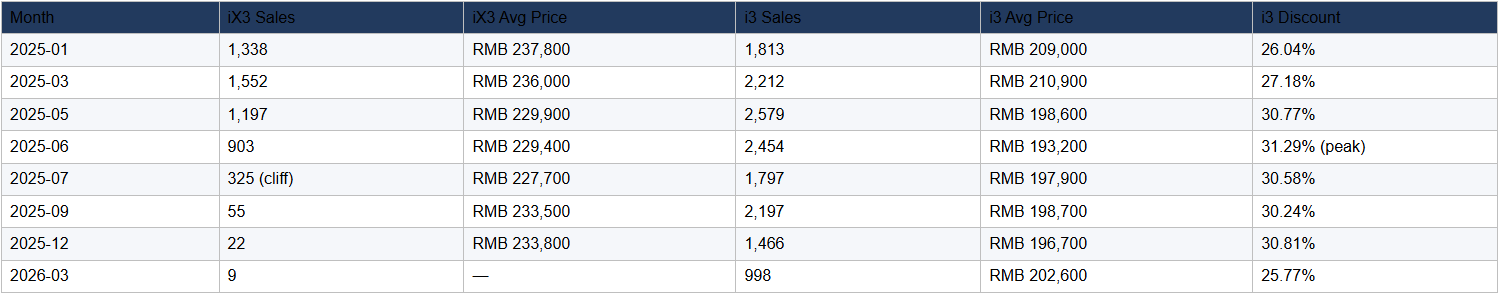
*Source: BMW iX3 and i3 monthly registration and transaction price data. Discount rate is BMW brand median.
The numbers tell the story clearly:
First, iX3 sales saw a cliff drop in July 2025 — from June's 903 units directly to July's 325 units (-64%), then 103 in August, 55 in September, then stabilizing at double digits. This is not a natural shrinkage of terminal demand, but the typical curve of proactive discontinuation to clear capacity for the Neue Klasse iX3. From Q1 2025 to Q1 2026, iX3 sales dropped from 3,931 to 32 units, a YoY decline of 99.19%.
Second, iX3's transaction price stayed relatively stable in the RMB 230,000 range — meaning despite aggressive terminal discounts (MSRP ÷ price ≈ 1.74), BMW didn't blindly "dive" in the final stage, but cleared inventory at a measured pace and switched capacity to the new model.
Third, i3 alone supports BMW's BEV base in China. Q1 2025 i3 sales were 5,413 units, dropping to 2,338 in Q1 2026 (▼56.8%), but it's still BMW's absolute leader in BEVs. i3's discount rate fell from June 2025's peak of 31.29% to 25-30% in Q1 2026 — exactly the effect of BMW's January "official price cut + dealer discount tightening" combo.
▍Neue Klasse i3 Is No Longer a Q4 2026 Story
A product node that needs recalibration: latest industry information shows the Neue Klasse BMW i3 long-wheelbase localization timing has been postponed to 2027 — clearly out of sync with the earlier expectation of "Q4 2026 launch." Correspondingly, only the Neue Klasse iX3 long-wheelbase will launch in Q4 2026 as planned.
This means that for all of 2026, BMW's actual BEV mainline in China is just two cars: the current i3 (declining sales, high discount rate) + the Neue Klasse iX3 launching in Q4 (one model carrying the counterattack flag alone). This is a narrower product window than previously expected, and places higher demands on iX3's "launch performance" — it can't just be "a decent new car," it must be a sales engine that can independently support six months or more.
And the Neue Klasse i3 long-wheelbase has to wait until 2027 for localization, meaning the real "product portfolio counterattack" won't take shape until 2027.
IV. Can BMW Reverse Its "Losing to Domestic NEVs" Position in China?
Back to the original proposition: can the real money BMW threw at Chinese dealers buy room for a 2026-2027 counterattack? Three layered judgments:
▍Reversible Part: Premiumization and Brand Premium
Q1 BMW China's two highlights — M family sales +25%, MINI growth +25% — reveal an overlooked fact: luxury brands' real moat in China is not the RMB 200,000-300,000 price war zone, but the pyramid peak of "high emotional value, high personalization, high brand recognition." The Neue Klasse i3's Isle of Man Green M paint, illuminated M badge on the C-pillar, and the Neue Klasse iX3's mirror-finish Hofmeister kink and feathered rear lights — the productization of these details is exactly about positioning "M-flavored sport luxury" as iX3 and i3's core selling point. In the RMB 300,000-450,000 band, this play still has room.
▍Hard-to-Reverse Part: Intelligence Mindshare and Ecosystem Integration
Domestic brands have established the equation "intelligence = domestic brand" in Chinese consumers' minds. HarmonyOS Intelligent Mobility, NIO NOP+, XPeng XNGP, Li Auto AD Max — these intelligent driving brands have formed entrenched consumer perception. Although BMW has partnered with Momenta, Alibaba, DeepSeek, and Huawei HarmonyOS NEXT, "BMW's intelligence" hasn't yet formed a clearly differentiated label in Chinese consumers' minds.
More crucial is product iteration speed. BMW's "Panoramic Vision" was patented in 2021 but only mass-produced in 2026; whereas Xiaomi already deployed a similar concept on a production car by May 2025. On innovation speed, BMW is still paying the price of traditional multinational R&D pace.
▍The Real Bet: A Limited Q4 Launch Window
The real window is narrower than previously expected — only the Neue Klasse iX3 long-wheelbase launches in Q4 2026; the Neue Klasse i3 long-wheelbase has to wait until 2027 for localization. This means:
(1) During Q2-Q3 fiscal quarters, BMW will continue to rely on the current product portfolio in China to maintain the base; in this stage, volume and price pressure are essentially certain, and the 2025-style "dealer transfusion" mode may continue.
(2) After the Neue Klasse iX3 launches alone in Q4, 2027 will be the real "product portfolio test" — by then, the Neue Klasse i3 will be localized, and the new 3 Series and X5 will gradually appear. BMW's real test is: can it establish a stable share in the RMB 300,000-450,000 band through "product strength + localization," rather than being forced to discount to RMB 250,000-300,000 to engage in close combat with domestic new forces.
V. Conclusion: Hold the Margin Discipline, Wait for Neue Klasse Validation
BMW's Q1 2026 earnings present three layers of signals.
First, the global framework remains stable. Group margin held within guidance range, free cash flow significantly improved, financial services penetration broke 50% — the profit model itself shows no structural loosening.
Second, the cost of the China market has been made explicit. The financial support BMW provided to Chinese dealers in 2025, the €2.5 billion annual cost reduction offset, the halving of automotive free cash flow guidance — behind these numbers is a multinational luxury brand's conscious "financial concession" to navigate the toughest period in the China market. This effort is itself a form of strategic restraint: BMW didn't crush dealers with a more aggressive price war as some brands did, nor did it allow channels to collapse; instead, it chose to use Group profit to buy channel survival.
Third, the Q4 launch of Neue Klasse models is a limited window. Whether BMW can reverse its "losing to domestic NEVs" position depends on whether the Neue Klasse iX3 can establish a stable brand premium space in the RMB 300,000-450,000 band — exactly the band where domestic new forces have the strongest product strength and deepest mindshare. And with the Neue Klasse i3 long-wheelbase having to wait until 2027, throughout 2026, the Neue Klasse iX3 will single-handedly carry BMW's entire BEV counterattack burden in China.
Back to the question at the start of this p: is China a pillar or a drag?
In the short term, it's a drag — it directly consumes Group Q1 profit growth space, and in 2025 it ate up half of automotive free cash flow.
In the long term, it's a pillar — it is BMW's incubator for Neue Klasse technology, the largest demand pool for the BMW M family, and the key litmus test for a luxury brand's "premiumization path."
— For a luxury brand labeled with technology openness and long-termism, BMW's Q1 is not the answer, but a midterm test of "patience." The Q4 launch of Neue Klasse iX3 will be the real moment for grading. Until then, what BMW needs to do is keep holding "margin discipline" — and in China, keep deepening "product strength + localization."
This path is slow, but stable. Slow, because product cycles objectively exist; stable, because the restraint of not engaging in pointless price wars is itself a form of long-termism.